

Description
DietPress is a free WordPress speed optimization plugin with a built-in page cache. Page caching, browser caching, GZIP and Brotli compression, deferred JavaScript, critical CSS, image loading attributes, preloading, locally hosted Google Fonts and selective asset loading, all in one plugin and all free.
And it goes further than a caching plugin: it also puts WordPress itself on a diet, switching off the features your site never uses. It pairs that with a clean, risk-based interface. Everything is configurable, the optimizations are already on by default, and nothing is hidden behind a paid tier. Activate it and your site is faster, or open the settings and tune every detail.
By default WordPress loads functions, services and scripts that most sites do not need. They slow down loading times and consume hosting resources. DietPress lets you trim that fat and apply battle-tested performance tweaks, with a clear description of what each option does and what might break, organized by risk level so you always know what is safe.
WHY CHOOSE DIETPRESS
- Page caching, for free. Serve anonymous visitors a copy stored on disk instead of building the page again. The feature people buy WP Rocket or a NitroPack subscription for, with no licence and no monthly fee.
- Served by your web server, not by PHP. With the accelerator on, Apache or nginx hands out the stored copy by itself, without starting PHP or WordPress, and so can LiteSpeed when the test passes there. It is tested on your home page before it stays on, and cached pages still expire on time.
- No drop-in, no changes to wp-config.php. Unlike WP Super Cache or W3 Total Cache, DietPress installs no
advanced-cache.phpand never editswp-config.php. Switching it off leaves your site exactly as it was, with nothing orphaned behind. - It tells you why. Most cache plugins leave you guessing when nothing is cached. DietPress reports its own status, tests itself against your home page, and names the exact reason a page was skipped.
- WooCommerce-safe by design. Carts, checkout, my account and any visitor carrying a cart cookie always get the live site, so nobody ever sees somebody else’s basket.
- Diet as well as speed. Where Perfmatters focuses on disabling scripts, DietPress covers that ground and adds page caching, critical CSS, local Google Fonts and a dashboard, admin and email cleanup, in one plugin.
- Light on your server. No account, no external service, no telemetry, no upsell nags. Everything runs on your own hosting.
WHAT THE PAGE CACHE DOES TO YOUR RESPONSE TIME
Measured on a WordPress 7.1 install with Astra, WooCommerce and 29 active plugins, PHP 8.5 and Apache, taking the median of 15 requests per URL. Your own hosting will give different figures, but the shape of the result will not change.
Server response time for the same pages without the page cache, with the page cache served by PHP, and with the accelerator:
- Home page – 112.3 ms without, 13.7 ms with the page cache, 3.0 ms with the accelerator
- A blog post – 105.5 ms without, 14.9 ms with the page cache, 3.0 ms with the accelerator
- WooCommerce shop – 117.2 ms without, 14.9 ms with the page cache, 3.8 ms with the accelerator
The interesting part is not the percentage, it is that the cached figures barely move. Serving a stored file costs the same whether the page was cheap or expensive to build, so the saving grows with the size of your site rather than with the power of your server. The accelerator also takes away the start of WordPress itself, which is most of what a page served from the cache by PHP still costs.
It also changes how much traffic your hosting can take at once. In the same test the home page went from about 17 visits a second without the page cache to 159 with it and 732 with the accelerator, more than forty times as many, on exactly the same machine. That is what keeps a small site standing up when one of your posts does well.
TWO THINGS IN ONE PLUGIN
1. Performance optimizations (on by default)
- Automatic Critical CSS inlined in the head (optional experimental deferral of non-critical CSS)
- JavaScript defer parsing with smart dependency handling
- Image loading attributes safety net: lazy loading, decoding=async and fetchpriority for images that bypass core
- Automatic image dimensions for better CLS scores (including picture elements)
- Resource hints: preconnect and DNS prefetch for common third-party origins
- Theme stylesheet, critical fonts and logo preloading for a faster LCP
- Google Fonts display=swap
- Google Fonts local hosting: serve the fonts your theme uses from your own server, GDPR-friendly with a silent fallback to the Google CDN (opt-in)
- Selective third-party loading: WooCommerce, Contact Form 7, block library, Slider Revolution, TablePress, Smash Balloon, Formidable Forms and Everest Forms assets only load where they are used (opt-in)
- RSS feed optimization (cache headers and item limit)
- Server rules in .htaccess: browser caching with a configurable lifetime for media, for styles and scripts and for fonts, GZIP and Brotli compression, immutable cache headers, CORS for fonts and keep-alive (master switch plus per-feature toggles)
- Database maintenance: daily expired-transient cleanup and safe query optimizations
- Page cache: store each page on disk and serve it to anonymous visitors without building it again, with automatic purging, gzip precompression, a cleanup schedule you choose and a status panel that says whether it is working, plus an accelerator that lets Apache or nginx serve those pages without starting PHP (opt-in, in its own tab)
2. Put WordPress on a diet (risk-based, opt-in)
- Light (safe for any site): emojis, RSD/WLW tags, shortlinks, self-pingbacks, comment pagination, and more
- Moderate (evaluate first): oEmbed, jQuery Migrate, Dashicons on the frontend, Global Styles and Duotone, remote block patterns, avatars and Gravatar, comment threading, and more
- Strict (site-specific): granular RSS feed control, Heartbeat API mode, post revisions and autosave, disable comments, XML sitemap, native lazy loading/fetchpriority, content types, selective loading for WooCommerce, Contact Form 7, block assets, Slider Revolution, TablePress, Smash Balloon, Formidable Forms and Everest Forms, and more
- Widgets: dashboard widgets (including third-party ones from Yoast, WooCommerce, Elementor, Jetpack, Wordfence, Rank Math, Gravity Forms), classic sidebar widgets, block-editor widgets and the Customizer
- Emails: silence the automatic emails WordPress sends on its own, grouped by area: auto-update results for core, plugins and themes (plus the new-version notice), comment moderation and new-comment notices, and new user, password and email-change notices, plus toggles for the admin email verification prompt and post-by-email. Every option is off by default, and critical notices such as a failed core update are always kept
SCALE, PROFILES AND ANALYZER
- Savings indicator: HTTP requests removed, CSS/JS saved and active optimizations at a glance
- Quick profiles: Personal Blog, WooCommerce Store, Landing Page and Maximum Cleanup
- Site analyzer: personalized recommendations based on your active plugins and content, page cache included
- Import and export your whole configuration as a JSON file
COMPATIBILITY AND EXTENSIBILITY
The plugin includes filters for developers:
dietpress_critical_css– Customize the inline critical CSSdietpress_critical_css_handles– Define which CSS handles are criticaldietpress_skip_defer_script_handles– Opt scripts out of the JavaScript deferdietpress_skip_defer_style_handles– Opt stylesheets out of the CSS deferraldietpress_preconnect_hints– Customize preconnect originsdietpress_dns_prefetch_domains– Customize DNS prefetch domainsdietpress_critical_fonts– Define critical fonts to preloaddietpress_exclude_local_fonts– Exclude Google Fonts stylesheets from local hostingdietpress_selective_{module}_has_content– Mark a page as showing the content of a selective loading module, so its assets are kept. The module iswc,cf7,formidable,everest_formsorrevsliderdietpress_selective_{module}_styles/dietpress_selective_{module}_scripts– Adjust the handles removed by each moduledietpress_selective_page_hides_content– Mark a page as rendering content the content scan cannot reach, so no module removes anything (this is what handles Elementor)dietpress_selective_is_wc_page– Override the WooCommerce page detection of selective loadingdietpress_selective_wc_keep_cart_fragments– Keep the cart fragments script when your theme has a hand-coded mini-cartdietpress_selective_cf7_has_form– Mark pages that load a Contact Form 7 form dynamicallydietpress_selective_blocks_dequeue– Override the block library dequeue decisiondietpress_selective_everest_forms_dequeue_dashicons– Keep Dashicons when another plugin enqueues it directlydietpress_native_sitemap_in_use– Tell DietPress your plugin builds on the native WordPress sitemap, so the option that removes it becomes unavailabledietpress_cache_bypass– Keep the current page out of the page cachedietpress_cache_bypass_request– Keep a request away from the page cache altogether, before anything is read from diskdietpress_cache_bypass_accept– Adjust the media types that keep a request out of the page cachedietpress_cache_bypass_cookies– Adjust the cookie name prefixes that make a visitor uncacheabledietpress_cache_ignored_params– Adjust the query parameters that do not change the pagedietpress_cache_exclude_urls– Adjust the excluded URL patternsdietpress_cache_post_urls– Adjust the URLs purged along with a post
Compatible with:
- Well-coded themes and page builders (Divi, Elementor, Beaver Builder, Bricks Gutenberg)
- Cache plugins (WP Rocket, LiteSpeed Cache, W3 Total Cache, WP Super Cache, etc.). The one exception is the optional page cache module, which will not run beside another page cache and says so; everything else in DietPress works alongside them as it always has
- Security plugins (DietPress focuses on performance and deliberately leaves security to them; we recommend our free Vigilant). With the page cache accelerator on, the pages the server serves by itself skip what they do in PHP, as the FAQ explains
- CDNs (Cloudflare, StackPath, KeyCDN, etc.) thanks to CORS and Vary headers. Behind a CDN or proxy, the page cache needs WordPress to know when a visit arrives over HTTPS, and the Cache tab tells you when it does not
- WordPress Multisite (except the optional page cache module, which does not support it yet)
HOW TO VERIFY THE OPTIMIZATIONS
- Cache rules: check your
.htaccessfor a block marked# BEGIN DietPresswithimmutableCache-Control headers - Page cache: open a page in a private window and look at the
X-DietPress-Cacheresponse header:HIT-STATICwhen the server served it without PHP,HITwhen PHP served it from the cache,MISSwhen it was built - Accelerator rules: on Apache or LiteSpeed, your
.htaccesshas a block marked# BEGIN Page Cache by DietPressright before the WordPress block - Logo preload: view page source and look for
<link rel="preload" ... fetchpriority="high">pointing to your logo - Critical CSS: view source and look for
<style id="core-diet-critical-css">in the head - Compression: test at giftofspeed.com/gzip-test
Always measure with tools like Google PageSpeed, GTMetrix or WebPageTest, and run each test at least twice to account for caching.
Support
Need private support or custom development?
Do you need one-on-one help, priority troubleshooting, or a custom feature, integration, or tweak built specifically for your site? I offer private support and custom development. Just contact me and tell me what you need.
Need help or have suggestions?
Love the plugin? Please leave us a 5-star review and help spread the word!
About AyudaWP
We are specialists in WordPress security, SEO, AI and performance optimization plugins. We create tools that solve real problems for WordPress site owners while maintaining the highest coding standards and accessibility requirements.
Screenshots


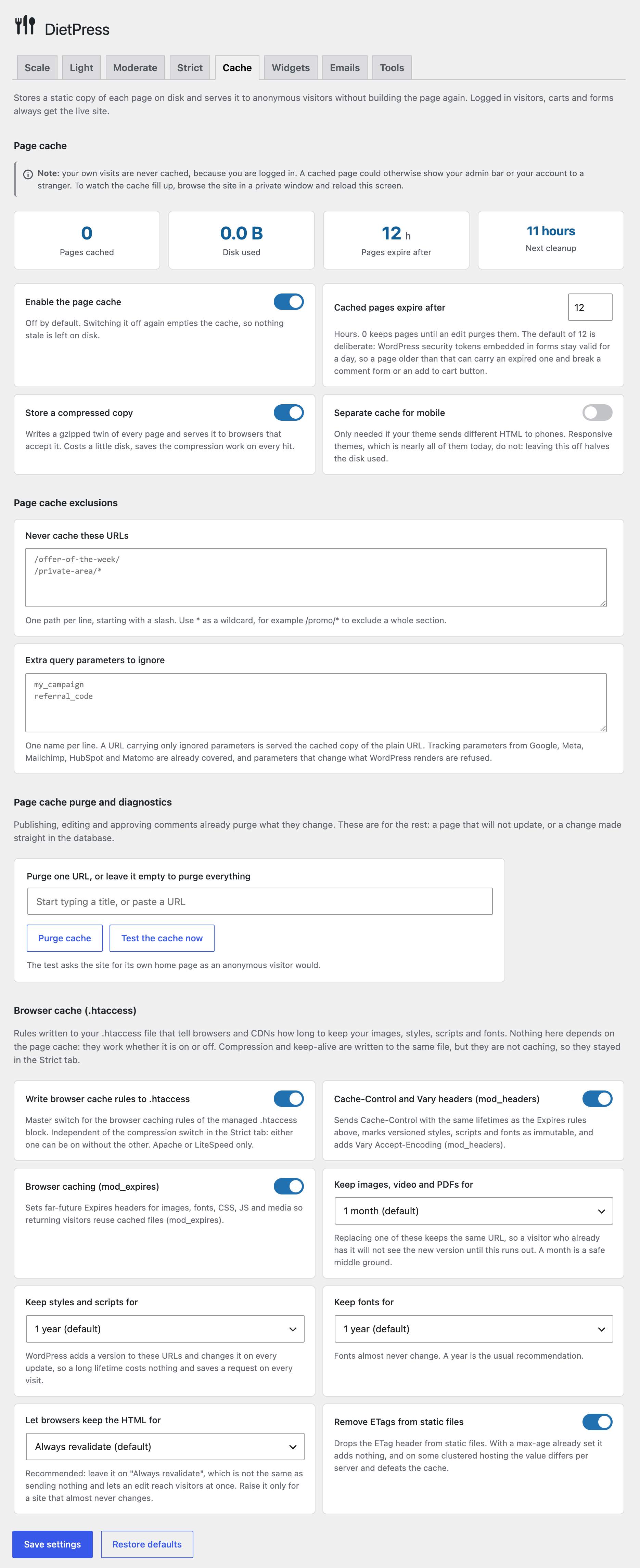
Installation
- Go to your WP Dashboard > Plugins > Add New and search for ‘DietPress’, or upload the
wpo-tweaksfolder to/wp-content/plugins/. - Activate the plugin through the ‘Plugins’ menu in WordPress.
- Open the DietPress menu to review the settings. Performance optimizations are already on; the diet options are off until you enable them.
FAQ
-
What does a page cache actually do, and do I need one?
-
Every time somebody visits your site, WordPress queries the database, runs your plugins, builds the page from your theme and sends it. For a visitor who is not logged in, the result is the same every time until you change something, so doing all of that again is wasted work.
A page cache does it once and stores the finished HTML on disk. The next visitor gets that file, skipping the database, the theme and most of the loading time. It is normally the single biggest speed gain a WordPress site can get, and it is also what keeps a small hosting plan standing up when a post does well on social media.
You need one unless your hosting already provides it. DietPress detects the usual managed hosts and tells you when that is the case.
-
What is the accelerator, and should I switch it on?
-
The page cache normally serves its stored copy from PHP, as soon as WordPress has loaded the plugins. That skips the database and the theme, but not the start of WordPress itself, and on a site with many plugins that start is most of what a cached page still costs.
The accelerator removes that start too. On Apache, DietPress writes a block of rules to your .htaccess, marked Page Cache by DietPress, and the server hands out the stored copy by itself, without starting PHP or WordPress at all. That is the fastest a page can be served. On nginx, which does not read .htaccess, the Cache tab gives you the same rules to paste into your server configuration.
Phones are served by the server too. With the separate mobile cache on, each address has a copy built for a phone and one built for a desktop, and the rules hand out the right one with the same test WordPress uses, so what PageSpeed measures on mobile is the served copy. Those pages go out with a Vary header, so a CDN or proxy in front keeps the two apart.
Switch it on once the page cache is working, if your site runs on Apache (with mod_rewrite and mod_headers, which nearly every hosting has) or nginx, which is where it has been measured. LiteSpeed reads the same rules as Apache, and there the test is what tells whether they work. It is tested on your home page the moment you switch it on: if the server does not serve that page by itself, with its headers and for the right scheme, the rules are taken out again and the tab says why. Everything the rules leave alone, a logged in visitor, a URL with a query string, a forced reload, is still served or rebuilt by PHP, exactly as without it.
Stored pages still expire on time, even on a site so well cached that WordPress hardly runs its scheduled tasks: each copy is linked under the name of every hour it is still valid in, and the server only looks for the current one. The one exception is the night the clock of the server goes back, when a copy can be served for up to an hour longer. Those extra names are also why a backup that includes wp-content/cache can grow: exclude that folder, as most backup plugins already do, because a backup that does not keep hard links stores each name as a file.
-
Does the accelerator bypass my security plugin?
-
Partly, and it is worth knowing how. The server answers before any PHP runs, so whatever a security plugin does in PHP does not see those visits: blocking an IP address, rate limiting, a bot filter or an under attack challenge. The rules a security plugin writes to your .htaccess, or to the server configuration, still apply: a bot that those rules block still gets its 403 on a page the server serves, while a client that is only blocked in PHP gets the cached page. The same goes for a site closed at server level, by IP address or with a password: on Apache the stored copies are only reachable through the address of their page, which those rules protect. On nginx, see the next question. Pages are never served this way to a logged in visitor or to one with a cart.
If your site relies on the PHP side of a security plugin for anonymous visitors, leave the accelerator off. Keep in mind that the page cache answers very early without it too, before many security plugins run their checks.
-
How do I use the accelerator on nginx?
-
nginx does not read .htaccess, so DietPress cannot write the rules for you. With the page cache on, the Cache tab shows them in four parts, each with a comment that says where it goes in the configuration of your site: two inside the server block, one at the start of the location that handles your pages, and one in the location that passes PHP files to PHP-FPM. Paste them, check the configuration with nginx -t, reload nginx and then switch the accelerator on, which tests them on your home page before it stays on. The rules also close the cache folder, which nginx would otherwise let anyone read by its address. One thing to check before pasting: access rules inside your location / block (allow, deny, auth_basic or auth_request) do not reach the pages served from the cache, because nginx sends the request on before it looks at them. Move them up to the server block, or repeat them inside the location of part 2, as its comment says.
If you later change an exclusion, the cookies that keep visitors out, the separate mobile cache or how long browsers keep pages, the tab says the rules changed: paste them again and reload nginx. On a managed hosting where you cannot edit the nginx configuration, leave the accelerator off; the page cache keeps working through PHP.
-
How do I check that the accelerator is working?
-
Open a page in a private window and look at its response headers in the developer tools of your browser: X-DietPress-Cache: HIT-STATIC means the server served it without PHP, HIT means PHP served it from the cache, and MISS means it was built. The first visit to a page after it changes is always a MISS. “Test the cache now” in the Cache tab does the same check for you on the home page. It switches the accelerator off if the server fails that page where the accelerator serves it (with an error, with a copy missing its headers, or with something other than the page DietPress stored) while WordPress still builds it fine. When the accelerator is switched on but cannot run, the test names the reason, and if the server is still answering from the cache by itself, it takes away the names the server finds the stored pages under.
-
How were the speed figures in the description measured, and can I repeat them?
-
On a local WordPress 7.1 install with Astra, WooCommerce and 29 active plugins, on PHP 8.5 and Apache. Each URL was requested twice to warm up and then fifteen times straight to the web server, and the median was taken; the visits per second come from 300 requests with ten in flight at a time, with the security plugin of the site told not to rate limit them. The only things that changed between the three columns were the page cache and accelerator switches, on the same content, in the same session.
You can repeat it on your own site with any tool that reports time to first byte. From a terminal,
curl -o /dev/null -w "%{time_starttransfer}\n" https://yoursite.com/a dozen times with the cache off, then a dozen with it on, and compare the medians rather than any single reading. Do it while logged out, because your own visits are never cached.Two honest caveats. A local install has no network latency, so the absolute milliseconds are lower than you will see in production, where the saving is usually larger rather than smaller. And these numbers say nothing about a Lighthouse score: that measures mostly what the browser does with your theme and your scripts after the page arrives, which is a different problem from how fast your server answers.
-
What is critical CSS and why does it matter?
-
A browser will not paint anything until it has downloaded every stylesheet in the page. Those files are render-blocking: your visitor stares at a blank screen while they arrive.
Critical CSS is the small subset of rules needed to draw what fits on the screen at first sight. DietPress writes it straight into the page, so the browser can paint immediately and load the rest of the styles afterwards. It is the usual fix for the “eliminate render-blocking resources” warning in PageSpeed Insights, and it improves Largest Contentful Paint, one of the Core Web Vitals Google measures.
-
What does deferring JavaScript do?
-
By default a script tag stops the browser: it downloads the file, runs it, and only then carries on reading your page. A theme with half a dozen scripts in the head can hold the first paint for a second or more.
Deferring tells the browser to keep building the page and run the scripts once it has finished. Nothing is removed and nothing loads later than it should, it just stops blocking. DietPress handles the dependency order for you and lets you exclude any script that misbehaves, from the settings or with a filter.
-
Why should I host Google Fonts on my own server?
-
Two reasons. Speed: a font from fonts.gstatic.com needs a fresh DNS lookup, TCP connection and TLS handshake to a domain the browser has never contacted, and browser cache partitioning means the visitor gets no benefit from having downloaded that font on another site. Privacy: serving them from Google transfers your visitor’s IP address to Google, which German and other European courts have ruled a GDPR violation.
DietPress downloads the fonts your theme uses to your own uploads folder and rewrites the stylesheets to point there. If anything fails it quietly falls back to Google, so a font never goes missing.
-
What is selective loading?
-
Plugins tend to load their CSS and JavaScript on every page of your site, whether or not the page uses them. A contact form plugin loads its scripts on every blog post; a slider plugin loads its libraries on pages with no slider; WooCommerce loads its cart on your About page.
DietPress detects which pages actually use each one and removes the rest, for WooCommerce, Contact Form 7, the block library, Slider Revolution, TablePress, Smash Balloon, Formidable Forms and Everest Forms. Pages built with a builder such as Elementor keep everything, because their content is not readable from the database and guessing there is how things break.
-
What is browser caching and how is it different from the page cache?
-
They cache different things for different people. The page cache stores your HTML on your server, so the next visitor is served it without rebuilding the page. Browser caching tells each visitor’s own browser to keep your images, styles, scripts and fonts on their machine, so their second visit downloads almost nothing.
You want both, and they do not overlap. DietPress lets you set how long each family of files is kept: media, styles and scripts, and fonts, each on its own, because the right answer is different for each.
-
What does “let browsers keep the HTML for” do, and why is zero the default?
-
It decides how long a visitor’s browser may reuse the page itself, as opposed to its images and styles. Zero, “Always revalidate”, is not the same as sending nothing at all.
With no answer at all the browser invents a lifetime of its own, normally about a tenth of the age of the document, which on an old page can be hours and is entirely out of your hands. With “Always revalidate” the browser asks every time, and the usual answer is a 304 Not Modified of a few hundred bytes, so the page is not downloaded again either: you get almost all of the saving and none of the staleness.
Raise it only for a site that genuinely almost never changes, and be aware of the trade: an edit then takes that long to reach anyone who has already visited, because their browser will not even ask. This one is sent as an HTTP header rather than an .htaccess rule, so it works on nginx too, and pages served from the cache follow it as well, whether PHP or the server hands them out. Above zero it also tells a CDN or a proxy in front of the site that it may keep the page, which a purge in DietPress does not reach.
-
What is the difference between Light, Moderate and Strict?
-
Risk, not importance. Light is safe on any site: things nobody misses, like the emoji script or the Windows Live Writer tag. Moderate deserves a look first, because a plugin or theme might use it, oEmbed or jQuery Migrate for example. Strict depends on what your site actually does: disabling comments, feeds or a whole content type is only right if you really do not use them.
Every option says what it does and what might break, and the Scale tab analyses your site and recommends only what applies to you, so you never have to guess.
-
What are Core Web Vitals and does this help with them?
-
They are the three measurements Google uses to judge how a page feels: how quickly the main content appears (LCP), how quickly the page responds to a click (INP) and how much things jump around while loading (CLS).
DietPress works on all three. The page cache and preloading cut the time to the first byte and to the largest element; deferring JavaScript and trimming what loads leaves the main thread free to answer clicks; and adding width and height to images that lack them stops the layout from shifting as they arrive.
-
Is it zero-config?
-
Yes, if you want it to be. The performance optimizations are on by default, so you can just activate and go. The difference is that now you can fine-tune everything and, optionally, put WordPress on a diet by disabling features you do not use.
-
Will it break my site?
-
The performance optimizations are designed to be safe and are tested across many sites. The diet options only change something when you explicitly enable each toggle, and every option has a description of what might break. If something fails, turn the toggle off; deactivating the plugin restores default WordPress behavior.
-
How does Google Fonts local hosting work?
-
When you enable it (Light tab, Performance section), DietPress detects the Google Fonts stylesheets your theme enqueues, downloads the stylesheet and its font files once, stores them in your uploads folder, and serves everything from your own server. Visitors no longer connect to Google (faster fonts and GDPR-friendly, since no visitor data is sent to a third party). If any download fails, the fonts silently keep loading from the Google CDN. The local copies are refreshed when you switch themes and removed when you disable the option or deactivate the plugin. Fonts hardcoded by a theme outside the standard WordPress enqueue system are left untouched.
-
Selective loading removed something my site needs
-
Each selective loading module only removes assets where its target content is not detected, but unusual setups exist: a hand-coded header mini-cart, a form injected via AJAX, a slider printed by the theme, or a classic theme that reuses block styles everywhere. Turn the specific toggle off, or use the escape filters (
dietpress_selective_{module}_has_content,dietpress_selective_page_hides_content,dietpress_selective_wc_keep_cart_fragments,dietpress_selective_cf7_has_form,dietpress_selective_blocks_dequeue) to keep exactly what your site needs.Pages built with Elementor, and any request an Elementor Theme Builder template applies to, are left alone on purpose: their content lives in the database, out of reach of the content scan.
-
Do the TablePress and Smash Balloon modules dequeue anything?
-
No. Both plugins already have a conditional loading mode of their own, off by default in the case they cover, and those two modules simply turn it on for visitors. The plugin itself then loads its stylesheet when a table or a feed is rendered, so nothing can end up unstyled. The Formidable Forms module does dequeue, but it puts the plugin own footer fallback back in play for the same reason.
-
What does the Slider Revolution module do exactly?
-
It turns the “Include libraries globally” setting of Slider Revolution off for each visit, without saving anything and without touching your configuration. From there Slider Revolution decides on its own, exactly as if you had turned that setting off in its Global Settings: it loads its libraries in preview mode, when one of its shortcodes is in the content, when its widget is active, and on any page you listed in its own “List of pages to include RevSlider libraries”. DietPress only adds the cases its check misses, such as a shortcode inside a text widget or an archive page. If you already turned that setting off yourself, the module does nothing at all and your page list stays in charge.
One thing to know: with the global loading off, the
add_revslider()PHP function that some themes use to print a slider from a template refuses to render and shows a notice instead. That is how Slider Revolution behaves on its own, and the remedy is the one it documents: add those pages to its list. -
Why is one of the options greyed out, or telling me it does nothing?
-
Because it cannot do what it says right now, and saying so is better than letting you switch on something inert. Two things can happen. An option is unavailable when it would contradict another one or break another plugin: “Disable WordPress XML sitemap” while a plugin builds its own sitemap on top of the native one, or “Disable native lazy loading” and “Disable fetchpriority attribute” while “Enhance image loading attributes” is on and already sets those attributes itself. And an option simply says it has no effect when another option already covers it: the granular RSS feed toggles while “Disable ALL RSS feeds” is on, or the .htaccess sub-options while the master switch is off. Those ones stay usable, so you can set them up before turning the master switch on.
Whatever you had saved is kept. An option that cannot apply is not switched off behind your back: it stays stored and starts working again as soon as the thing blocking it changes.
-
Is it compatible with caching plugins and CDNs?
-
Yes. DietPress works alongside caching plugins and includes CORS and Vary headers for full CDN compatibility. Behind a CDN or proxy, the page cache needs WordPress to know when a visit arrives over HTTPS, as the rest of WordPress does: when the proxy headers disagree with the HTTPS WordPress detects, those visits are left out of the cache, and the Cache tab explains why and how to fix it.
-
Something went wrong after activation
-
If a plugin or theme does not enqueue scripts correctly, the JavaScript defer may affect it; you can turn that option off or use the
dietpress_skip_defer_script_handlesfilter. If you get a 500 error, edit your.htaccessand remove the blocks that start with# BEGIN Page Cache by DietPressand# BEGIN DietPress(or# BEGIN Zero Config Performanceif you updated from 2.x and the rules have not been rewritten yet), or disable the “.htaccess server rules” option and the page cache accelerator. -
Why is a page not being cached?
-
Open DietPress and go to the Cache tab, then press “Test the cache now”: the site asks itself for its own home page and tells you whether the server served it, PHP served it from disk, it was rebuilt, or it was skipped, and when it was skipped, the exact reason. If you need the reason for one particular page, turn
WP_DEBUGon and read the last line of that page’s HTML source: DietPress writes the reason there, for example that the response set a cookie or that a plugin declared the page uncacheable. A page that was stored gets no comment. And if you check the X-DietPress-Cache header in your browser’s developer tools, untick Disable cache there first: with it ticked, as with a forced reload, the browser asks for a fresh copy and DietPress rebuilds the page on purpose, so it shows MISS. An ordinary reload is served from the cache.The three usual causes are a plugin that sets a cookie on every visit (a consent banner, some analytics scripts), a page that is genuinely personal (cart, checkout, my account, a password protected post), and a cache directory the server cannot write to. The status panel reports the third one on its own. On a site behind a proxy or CDN there is a fourth one: proxy headers that disagree with the HTTPS WordPress detects keep those visits out of the cache. Those visits are left out before the page is built, so they get no comment in the HTML source, except when WordPress only learns about HTTPS later in the request, where the comment says that HTTPS changed after the cache lookup. Either way the Cache tab tells you about them, and how to fix it.
-
I published a change and visitors still see the old page
-
Publishing, editing, deleting or renaming a post purges it and everything that lists it, and approving a comment purges the post it belongs to. Changing the theme, the menus, the widgets, the permalinks or the front page settings empties the whole cache, and so does activating or updating any plugin.
If a change made outside WordPress (straight in the database, or by an importer) is not showing, use the purge button on the Page Cache screen. And check with a private window first: DietPress asks browsers not to keep the HTML, but an aggressive browser cache, a CDN or a hosting cache in front of the site are outside its reach.
-
Does it work with WooCommerce?
-
Yes. WooCommerce marks the cart, the checkout and my account as uncacheable itself, and DietPress obeys that mark rather than guessing from the URL, so it keeps working if you move or rename those pages. On top of that, any visitor carrying a WooCommerce cart or session cookie is served the live site everywhere, so a mini cart in the header never shows somebody else’s basket. A store in “coming soon” mode is not cached at all.
-
Can I use it together with my other cache plugin, or with my hosting cache?
-
With another page cache plugin, no, and DietPress will not let you: two page caches on the same site serve each other’s stale HTML and the result is very hard to diagnose. If W3 Total Cache, WP Super Cache, LiteSpeed Cache, WP Fastest Cache, Cache Enabler, Surge, WP Rocket or any of about thirty similar plugins is active, the toggle stays disabled and says which one. Object cache plugins such as Redis Object Cache are a different thing and are fine.
With a hosting cache (Kinsta, WP Engine, SpinupWP, Cloudways and others) it is possible but rarely a good idea, because purging one does not purge the other. DietPress detects the usual ones and asks for an explicit confirmation before letting you enable it. On LiteSpeed servers the LiteSpeed Cache plugin is the other natural choice, since it caches at server level, so use one of the two. The accelerator of DietPress reads the same rules there as on Apache, and its test tells whether LiteSpeed serves the stored pages without PHP.
-
Are logged in users cached?
-
Never, and there is no option to change that. The same goes for anyone with a cart, an unlocked password protected post or a comment awaiting moderation.
-
Can I customize the optimizations as a developer?
-
Yes. See the filters listed in the description (the
dietpress_*hooks). The page cache addsdietpress_cache_bypass,dietpress_cache_bypass_request,dietpress_cache_bypass_accept,dietpress_cache_bypass_cookies,dietpress_cache_ignored_params,dietpress_cache_exclude_urlsanddietpress_cache_post_urls, thedietpress_cache_purge_allaction and thedietpress_purge_page_cache( $url )function. DefiningDIETPRESS_DISABLE_CACHEas true switches the engine off without deactivating anything; with the accelerator on, its rules and the names of the stored pages are taken out the next time an administrator opens the dashboard.With the accelerator on, the cookies, media types and URL patterns those filters return are written into the server rules, so a value added only on some requests, or only on the front end, does not reach them. A callback on
dietpress_cache_bypass_request, or onwp_is_mobilewith the separate mobile cache on, keeps the accelerator from running at all, because the server cannot run that code.
Reviews


Contributors & Developers
“DietPress” is open source software. The following people have contributed to this plugin.
Contributors

“DietPress” has been translated into 9 locales. Thank you to the translators for their contributions.
Translate “DietPress” into your language.
Interested in development?
Browse the code, check out the SVN repository, or subscribe to the development log by RSS.
Changelog
3.6.0
Page cache accelerator: your web server can now serve cached pages without starting PHP, tested on your home page before it stays on. Plus a cleanup schedule you choose and fixes for copies stored under the wrong address, device or scheme.
- New: Page cache accelerator. With it on, the web server hands out the stored copy of a page by itself, without starting PHP or WordPress, which is the fastest a page can be served; the page cache keeps working through PHP behind it for everything the server leaves alone, such as logged in visitors, URLs with a query string or a forced reload. On Apache it writes a block of rules to the .htaccess of the site, marked Page Cache by DietPress and placed right before the WordPress block; it needs mod_rewrite and mod_headers, and it serves the stored copies only through the address of their page, so the access rules of the site still apply to them. LiteSpeed reads the same block, and there too the test decides. On nginx, which does not read .htaccess, the Cache tab gives you the rules to paste into the server configuration, and they also close the cache folder, which nginx used to let anyone read by its address. Either way it only stays on when a test on the home page gets the page served by the server, with its headers and for the right scheme; if the test fails, it is switched off again and the tab says why. Stored pages still expire on time even when WordPress cron does not run, which on a site served almost entirely by the server is the usual case: each copy is linked under the name of every hour it is still valid in, and the server only looks for the current one; the night the server clock goes back, a copy can be served for up to an hour longer. The .htaccess of the cache folder is now rewritten whenever it says something other than what the settings need. On a server that does not hand PHP the environment variables set in .htaccess, which some hostings do not, the rules repeat the server clock in a request header instead, with a secret only the server knows, so the accelerator works there too. Phones get the copy built for them, with the separate mobile cache on, and those pages carry a Vary header so a CDN in front does not mix the two. Off by default; the site analyzer recommends it and the quick profiles switch it on. Because the server answers before any PHP runs, what a security plugin does in PHP, such as blocking an IP address or a bot, does not see those visits, while the rules it writes to .htaccess still apply. On LiteSpeed servers, the note of the Cache tab no longer says that the LiteSpeed Cache plugin is faster than this cache.
- New: The cleanup of expired pages can run every hour, twice a day or once a day, and at the hour of the site you choose, instead of always twice a day starting an hour after it was scheduled. The minute is spread per site, so sites on one server that pick the same hour do not all clean up at once. Sites that never change it keep the schedule they had.
- Improved: “Test the cache now” says whether the server or PHP served the home page, and names the exact reason when it was not served from the cache, such as a cookie, an excluded URL or a plugin that declares the page uncacheable. It also says when the answer did not come from WordPress at all, as with a static index.html in the root of the site, a CDN answering from its own cache or a password asked by the server, explains the usual cause when the site cannot reach its own address, and then tries again straight against the server. With the accelerator on, it tests the rules again on a site that moved, and switches the accelerator off when the server fails the home page where the accelerator serves it (with an error, with a copy missing its headers, or with something other than the page DietPress stored) while WordPress still builds it. When the accelerator is on but cannot run, it names the reason, and if the server is still answering from the cache by itself, it takes away what lets it do so.
- Improved: After applying a quick profile, the page says what happened to the page cache and to the accelerator. The message was already written, but the page reloaded before showing it.
- Fix: A plain reload rebuilt the page and stored it again, for every visitor who pressed reload, because browsers send max-age=0 on an ordinary reload and the cache took it for a forced one. Only a forced reload, which sends no-cache, rebuilds the page now; a request that asks for no-store is served from the cache as well.
- Fix: With the separate mobile cache off, a theme that sends different HTML to phones could have the version built for a phone stored and served to everybody. Astra, for one, puts its mobile header class on the page, so desktop visitors could get the mobile header. In that mode a page built for a phone is no longer stored; it is stored from desktop visits, and the Cache tab suggests the separate mobile cache when it happens.
- Fix: A page whose output buffer another plugin or the theme flushed or cleaned halfway through could be stored with only its end, and served that way to every visitor until it expired.
- Fix: A page sent with a Cache-Control header that forbids shared caches to keep it, no-store or private, as nocache_headers() sends, was stored and served to everybody. It is no longer stored, and “Test the cache now” names that reason.
- Fix: With canonical redirects switched off, a plain HTTP request naming a port in its Host header, such as example.com:443, was stored as the HTTPS copy of the page, with that port in its links wherever the theme prints the Host header, and visitors on HTTPS then got that copy. Requests whose port does not match the address of the site are left out of the cache now.
- Fix: Code that rewrites the requested address during the request, as some language plugins do, could make the cache store a page under the address of another one, so visitors of one language could get the page of another. A copy is now filed under the address that was asked for.
- Fix: In the store pages only mode of WooCommerce, a page that became the shop, the cart, the checkout, the terms or the coming soon page kept its public copy until it expired. Changing any of those pages now empties the cache.
- Fix: If storing a page stopped between the page and its compressed copy, the compressed copy of the previous version was left next to the new page and served to every browser that accepts gzip. The old compressed copy is now removed first.
- Fix: With deferred JavaScript on, a single visit claiming to be Internet Explorer 9 had its page stored without defer, and every visitor got that copy until it expired. The exception for that browser, unsupported for years, is gone.
- Fix: On a site that renames its login cookie in wp-config.php, with the LOGGED_IN_COOKIE constant, logged in visitors could be served the cached page anonymous visitors get. That cookie keeps them out of the cache now, the same as the standard one.
- Fix: A page served from the cache always told browsers to revalidate it, whatever “Let browsers keep the HTML for” said, while the same page built by WordPress followed that setting. Both follow it now. Sites that keep that setting at its default see no change.
- Fix: Deactivating the plugin from WP-CLI without a user left the scheduled cleanup of the page cache behind. It is removed now, whoever deactivates it.
For older changelog entries, please check the changelog.txt file.