

Description
Neuralis AI Identity Manager changes the way your WordPress site describes itself to machines.
Built for Generative Engine Optimization (GEO), Neuralis transforms WordPress from a page-centric system into an entity-centric one, creating a structured identity that AI systems and search engines can interpret.
Traditional WordPress websites are built around pages and posts. Neuralis adds an entity-centric layer where the real things behind your website — your organization, people, services, products and other entities — can exist independently from individual pages.
You define what exists, how those entities are connected, and what each page is primarily or secondarily about.
Neuralis handles the technical part, translating that information into structured data, JSON-LD Schema and a connected Knowledge Graph.
You don’t need to understand Schema.org, JSON-LD or Knowledge Graphs. You only need to know your own business.
Instead of asking machines to guess who you are from your pages, Neuralis gives you a structured way to tell them.
Features
- Entity-centric data model: entities exist independently from pages
- Guided entity creation without Schema.org or JSON-LD knowledge
- Relationships between entities
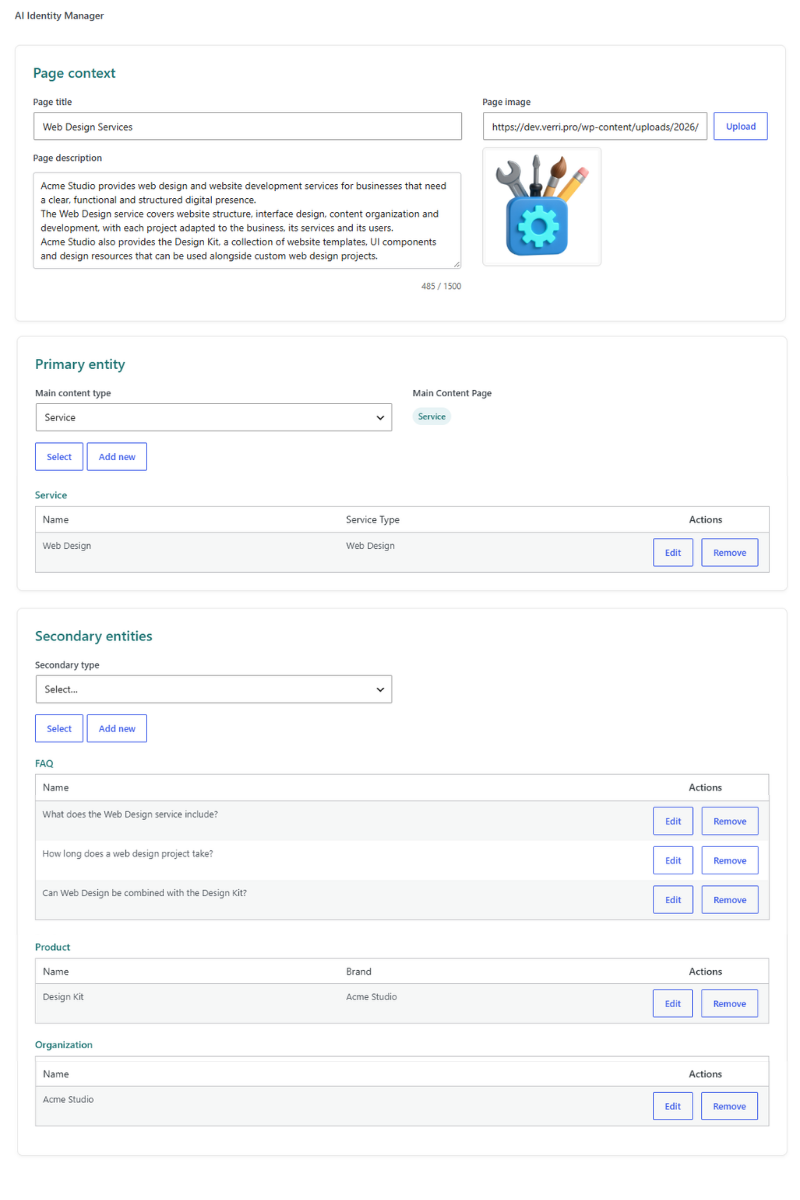
- Primary and secondary entity context for individual pages
- Automatic JSON-LD Schema generation from your entity model
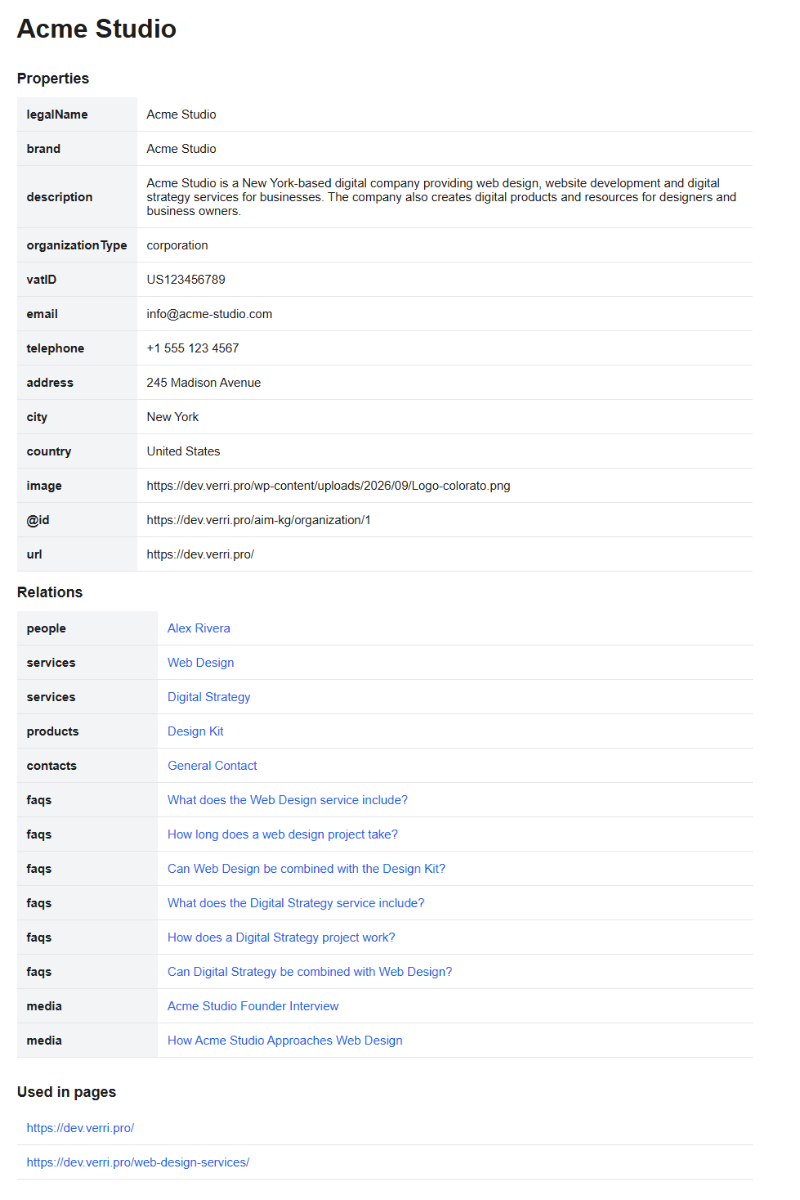
- Connected Knowledge Graph generated from the same semantic structure
- Structured identity designed to support Generative Engine Optimization (GEO)
- Automatic semantic downgrade when needed
- Free and Pro editions with clearly separated feature sets
Requirements
- WordPress 6.0 or higher
- PHP 7.4 or higher
- A properly maintained hosting environment
Older WordPress or PHP versions are not supported.
Usage
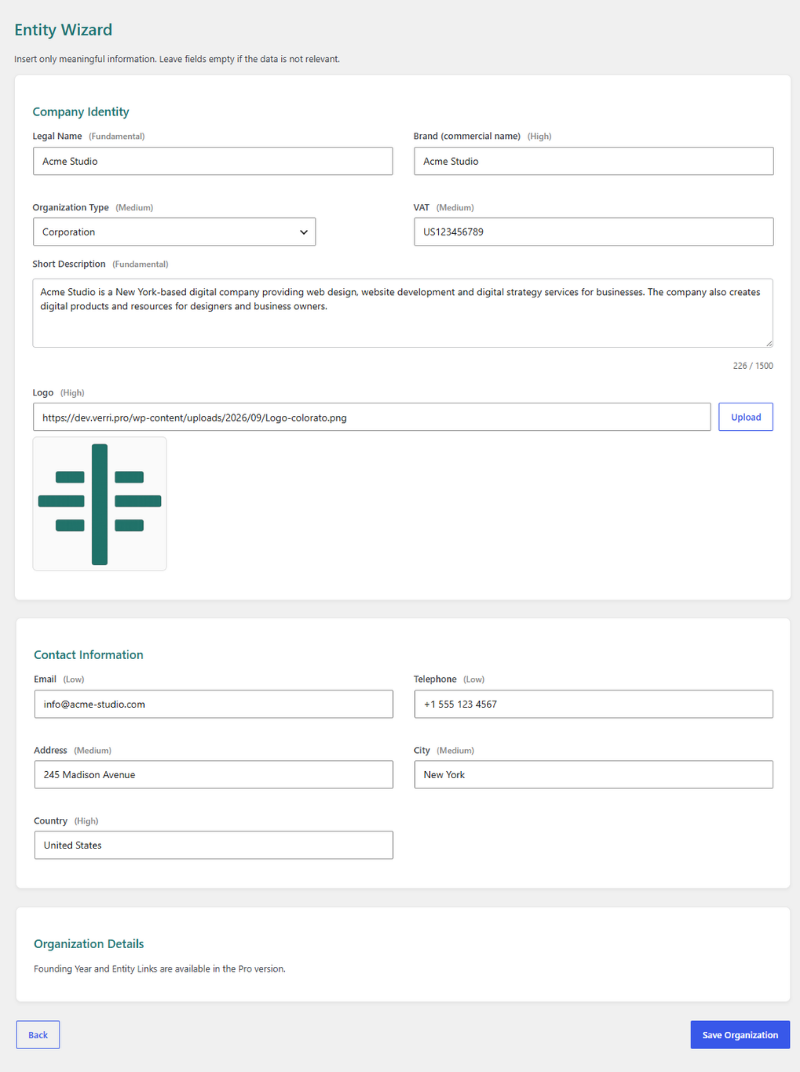
- Create the entities that represent your website using the built-in Entity Wizards, such as your Organization, People, Services or Products.
- Connect related entities to build your website identity.
- On your WordPress pages, use the Neuralis metabox to assign a Primary entity (what the page is mainly about) and, when relevant, Secondary entities (other subjects discussed on the page).
- Neuralis automatically translates this structure into JSON-LD Schema and a connected Knowledge Graph.
You don’t need to write Schema or manage the Knowledge Graph manually.
You define your identity. Neuralis handles the technical representation.
Beta Notice
This is an early release.
The core entity and semantic architecture is stable, while the user interface and feature set may continue to evolve.
Use in production environments only if you meet the minimum requirements.
Screenshots

Installation
- Upload the plugin folder to
/wp-content/plugins/ - Activate Neuralis AI Identity Manager from the WordPress admin
- Start creating entities using the built-in wizard
- Connect your entities to the pages where they are relevant
No coding or manual Schema editing is required.
FAQ
-
What is Neuralis AI Identity Manager?
-
Neuralis AI Identity Manager is a WordPress plugin for building a structured digital identity based on entities and their relationships. Instead of treating individual pages as the foundation of your site’s identity, Neuralis lets you define the real entities behind the website and connect your pages to them.
It then translates this structure into machine-readable data, including JSON-LD Schema and a connected Knowledge Graph.
-
What does “entity-centric” mean?
-
A traditional WordPress site is mainly organized around pages and posts. With an entity-centric model, things such as your organization, people, services and products exist as independent entities. Pages can then describe or reference those entities without becoming the entities themselves.
-
Is Neuralis a Schema plugin?
-
Neuralis automatically generates Schema.org structured data, but Schema generation is not its starting point. You define your entities, relationships and page context, and Neuralis uses that semantic model to generate the appropriate machine-readable representation.
-
What is Generative Engine Optimization (GEO)?
-
Generative Engine Optimization (GEO) is the practice of making information easier for AI-powered systems to discover, understand and use. Neuralis supports GEO by providing a clear semantic structure through entities, relationships, structured data and a Knowledge Graph.
Neuralis does not guarantee inclusion, citations or specific behavior by external AI systems.
-
Do I need to know Schema.org, JSON-LD or Knowledge Graphs?
-
No. Neuralis is designed so that you describe things you already know about your business or website. The plugin handles the technical representation.
-
What is an entity?
-
An entity represents a real thing or concept associated with your website, such as an organization, person, service, product or contact point. Entities exist independently from individual pages and can be connected to other entities and page contexts.
-
Do I need to rebuild my website?
-
No. Neuralis works alongside your existing WordPress content and structure.
-
What are Primary and Secondary entities?
-
The Primary entity describes what a page is fundamentally about. Secondary entities represent other subjects or entities that are also discussed on that page.
This gives Neuralis explicit semantic context instead of requiring machines to infer everything from the page text alone.
-
Do I need to use the metabox on every page?
-
No. Use it where you want to explicitly define the semantic context of a page. Articles can be handled automatically.
-
Do I need to create every possible entity?
-
No. Create only the entities that are meaningful to your website and its identity.
-
Can I use the same entity on multiple pages?
-
Yes. Entities exist independently from pages and can be referenced wherever they are relevant.
-
How many secondary entities can I add to a page?
-
Use as many as are genuinely relevant to the page. Adding unrelated entities does not improve the semantic structure.
-
Can an entity exist without being linked to a page?
-
Yes. Entities are independent objects and can exist in the Knowledge Graph even when they are not directly associated with a specific page. Connecting them to relevant content provides additional context.
-
Does Neuralis guarantee that AI systems will cite my website?
-
No. No plugin can control how external AI systems retrieve, interpret or cite information. Neuralis provides a structured semantic foundation designed to make your website identity clearer and less ambiguous to machines.
-
Will I lose my data if I stop using Pro?
-
No. Your data is not deleted. Entities or features exceeding the limits of the Free edition are not actively used where applicable, but their stored data is preserved and becomes available again if the corresponding Pro functionality is restored.
Reviews
There are no reviews for this plugin.
Contributors & Developers
“Neuralis AI Identity Manager” is open source software. The following people have contributed to this plugin.
Contributors

Translate “Neuralis AI Identity Manager” into your language.
Interested in development?
Browse the code, check out the SVN repository, or subscribe to the development log by RSS.
Changelog
1.0.21
- Improvement: Updated plugin description and documentation to better explain the entity-centric model and Generative Engine Optimization (GEO).
- Fix: Cleared stale Primary entity selection in the page metabox when switching to a page type without a
1.0.20
- Improvement: Updated the bundled Freemius SDK from 2.13.1 to 2.13.4.
1.0.19
- New: Added Event as a primary entity type.
- Improvement: Enhanced Knowledge Graph generation and entity relationship handling.
- Improvement: Refined primary and secondary entity management and persistence.
- Improvement: Improved downgrade behavior to preserve existing entity data.
- Improvement: Strengthened separation between Free and Pro features and distribution packages.
- Improvement: Standardized public WordPress identifiers using the NAIIM prefix.
- Fix: Improved entity selection and persistence across primary and secondary contexts.
- Fix: General compatibility and stability improvements.
1.0.18
- Fix: Streamlined core bootstrapping engine by removing legacy conditional path routing.
- Fix: Cleared unused hidden input fields from organizational and personal wizard templates.
- Improvement: Hardened validation layer to optimize historical meta preservation during entity data updates.
- Improvement: Refactored build automation conditional tags across administrative layout views.
1.0.17
- Fix: Resolved critical XSS and CSRF security vulnerabilities across admin asset injection and meta handling.
- Fix: Resolved nested data stripping by hardening the recursive input sanitization engine to natively preserve camelCase entity identifiers (e.g., fullName, shortBio, legalName).
- Fix: Total removal of Plugin Checker (PHPCS) diagnostic warnings concerning Nonce verification, global variable leakage inside wizard layout templates, and unescaped script outputs.
- Improvement: Formally hardened data handling on visual-only global array lookups (
$_GETand$_POST) to fully comply with WordPress.org review standards.
1.0.16
- Fix: Symmetrical update of all translation Text Domains for full brand alignment.
- Improvement: Enabled account management tab to easily manage multiple license activations.
1.0.15
- Fix: Core admin menu slugs and submenus fully aligned to fix permission and capability errors on fresh installations.
- Improvement: Declared compatibility up to WordPress 7.0.
1.0.14
- Improvement: Fully aligned Freemius SDK and slug identifiers to neuralis-ai-identity-manager.
1.0.13
- Improvement: Updated plugin identity and brand mapping to Neuralis AI Identity Manager.
1.0.12
- Improvement: Standardized Freemius premium code handling across all wizards.
- Improvement: Ensured safe data persistence for hidden PRO fields (no data loss on downgrade).
- Improvement: Improved admin navigation flow between entity list and wizards.
- Fix: Corrected premium-only block rendering to align with WordPress.org requirements.
- Fix: Resolved Plugin Check warnings (sanitization, nonce handling, safe queries).
1.0.11
- Improvement: Standardized Freemius premium code handling across all wizards.
- Improvement: Ensured safe data persistence for hidden PRO fields (no data loss on downgrade).
- Fix: Corrected premium-only block rendering to align with WordPress.org requirements.
1.0.10
- Improvement: Optimized code structure for better compatibility with the free version.
- Fix: Minor structural adjustments to ensure proper feature separation in the distribution package.
1.0.9
- Fix Freemius premium code stripping
1.0.8
- Fix Freemius free package build (premium code stripping)
1.0.7
- Fix: media uploader image field not saving correctly in Media Wizard
- Fix: ensured proper sync between UI fields and hidden fields before submit
- Fix: removed inline JavaScript from admin dashboard (WordPress.org compliance)
- Fix: removed inline CSS from Knowledge Graph system pages
- Fix: improved handling of request data with proper sanitization and unslashing
- Improvement: improved admin asset loading and script handling
- Improvement: strengthened nonce validation and security checks
- Improvement: hardened protection for system pages (edit, delete, trash)
- Improvement: refined Free/Pro handling logic for entities and fields
- Improvement: improved compatibility between free and premium feature sets
- Improvement: improved separation and stability between free and premium code paths
1.0.6
- Fix: output escaping in Service Wizard
- Fix: removed legacy price field from Product list
- Improvement: better offers display in Knowledge Graph pages
- Improvement: enhanced structured data output with software metadata for better attribution and interoperability
1.0.5
- Introduced structured Offer system for Product and Service entities
- Replaced single price field with support for multiple offers (price, currency, URL)
- Improved schema consistency for commercial entities
- Fixed Offer URL fallback logic (applies only when entity is primary and uses page URL)
- Prevented unintended Offer fallback behavior in Knowledge Graph output
1.0.4
- Fixed critical Free/Pro compatibility issues (Freemius integration)
- Prevented fatal errors when Free and Pro versions are active together
- Improved plugin bootstrap stability
- Fixed loading of premium-only wizard files
- Improved handling of premium features in Free build
- General stability improvements
1.0.3
- Improved WordPress.org compliance
- Fixed escaping and security issues across admin interface
- Improved input handling and validation
1.0.2
- Added license activation UI (Freemius account tab)
1.0.1
- Fix: Organization wizard now works correctly in free version
1.0.0
- Initial release
- Entity-based data model
- JSON-LD schema generation
- Knowledge Graph pages (/aim-kg/)
- Primary and secondary entity system
- Automatic semantic fallback system